

The short answer
Not always. A bone graft after a tooth extraction is usually worth it when you plan a dental implant in that spot, when the socket walls are thin or damaged, or for a front tooth where a dip in the gum would show. If the tooth won’t be replaced, you usually don’t need one. Dr. Ibrahim Sayeed decides from a 3D scan.
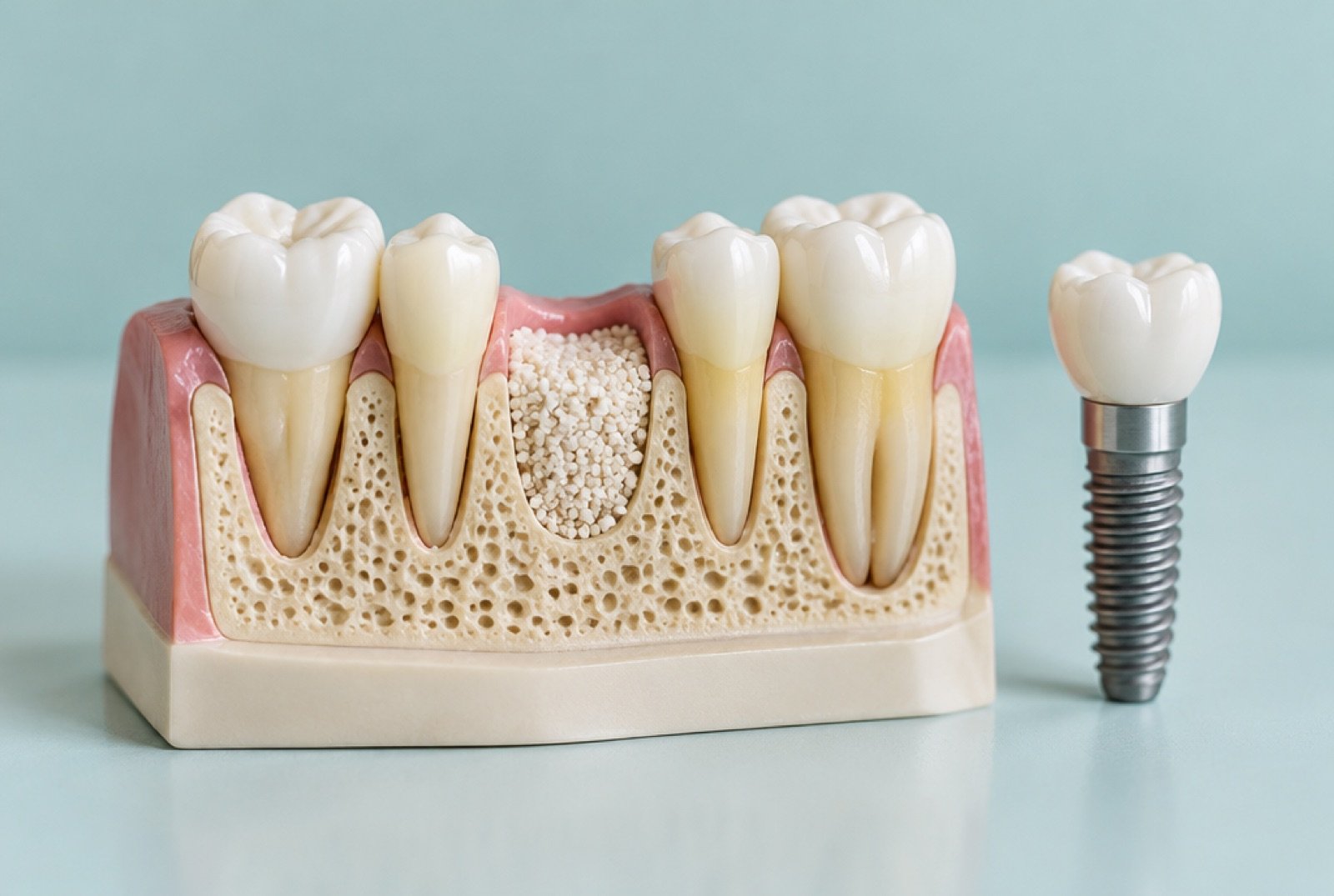
A socket graft, also called socket preservation, fills the empty socket with bone graft material at the same visit as the extraction. It works as a scaffold that your own bone grows into over the following months.
What happens to the jawbone if you don’t get a graft?
Without a tooth to support, the bone around the socket shrinks, fastest in the first three to six months. A review of studies found the ridge loses roughly a third to over half of its width, and some of its height, within six months. A later implant may then need a larger graft first. Grafting the fresh socket limits that shrinkage, though the research on how much it changes the final result is still uncertain, which is why it’s decided case by case.
How is a bone graft placed at the time of an extraction?
It adds only a few minutes. With the area still numb from the extraction, the socket is cleaned, filled with graft granules, often covered with a thin membrane, and closed with stitches. The material can come from a donor bank, an animal source, a lab-made mineral or, less often, your own bone. All of them are replaced by your own bone over time.
What is recovery like after an extraction with a bone graft?
Much like a normal extraction, which our tooth extraction page covers day by day. What the graft adds:
- A few sand-like granules in your mouth in the first days are normal.
- Tenderness, swelling or bruising settle within one to two weeks.
- Avoid alcohol for at least two weeks and hard exercise or heavy lifting for 48 hours.
- Don’t spit hard, swish or smoke, so the graft stays in place.
Call us if pain or swelling gets worse after the first week, or you notice pus or a fever.
How long after a bone graft can you get an implant?
Usually after about three months for a socket graft, and longer, up to nine to twelve months, for a larger graft. Once it has healed, the dental implant should go in within the next six to twelve months, before the grafted bone starts to shrink. Small grafts can sometimes be done at the same time as the implant. After that, read how long implant recovery takes.
Bone graft questions
Does a bone graft hurt?
The area is numbed, and most people have little pain afterward that settles with over-the-counter pain relievers.
Is it normal to see white grains coming out of the socket?
Yes, a few in the first days. If a lot come out, or the membrane comes away early, call us.
Can you get a bone graft years after a tooth was pulled?
Yes. The ridge can be rebuilt later, but it usually needs a larger graft and more healing time than grafting the fresh socket.
Having a tooth out and thinking about an implant? Book a consultation or call 845-336-5855.